
AGE-PRO
The ALMA Survey of Gas Evolution in PROtoplanetary Disks
ALMA Large Program | Project Code: 2021.1.00128.L | Cycle 8
PI: Ke Zhang (University of Wisconsin-Madison)
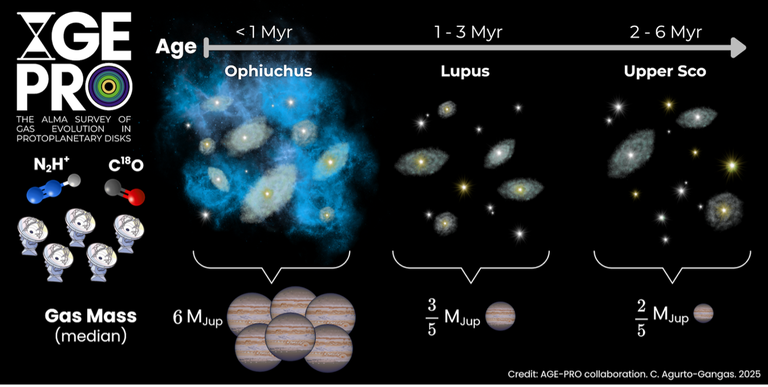
Associated image: Credit: AGE-PRO Collaboration, C. Agurto-Gangas / NSF/AUI/NSF NRAO/S. Dagnello.
1. Program Abstract
AGE-PRO (the ALMA Survey of Gas Evolution in PROtoplanetary Disks) is the first ALMA Large Program (103 hours) specifically designed to systematically trace the evolution of gas in protoplanetary disks. Gas is the dominant mass constituent of protoplanetary disks and its structure and evolution profoundly impact every major step of planet formation, including planetesimal formation, accretion of planetary atmospheres, and migration of planets. Yet a basic understanding of how the gas disk evolves and what mechanism drives its global evolution has been lacking.
Through deep molecular line observations of a carefully selected sample of 30 disks around M3–K6 stars in three nearby star-forming regions—Ophiuchus (0.5–1 Myr), Lupus (1–3 Myr), and Upper Scorpius (2–6 Myr)—AGE-PRO provides an unprecedented view into how the gas content in disks evolves over time. By combining observations of CO isotopologues and N₂H⁺ with advanced thermo-chemical modeling, AGE-PRO delivers robust measurements of disk gas mass and size for the full 30-disk sample.
Key findings include: (1) the median gas disk mass decreases with age, from ~6 MJup in Ophiuchus to ~0.68 and ~0.44 MJupin Lupus and Upper Sco; (2) gas and dust disk masses evolve on different timescales, evidenced by a “swing” in the gas-to-dust mass ratio; and (3) surviving disks retain more gas than expected, with implications for giant planet formation timescales. These findings are compared against key theoretical frameworks of disk evolution, including turbulent viscosity and magneto-hydrodynamical (MHD) disk winds. We find the AGE-PRO results favor the MHD disk wind mechanism over the viscous evolution.
AGE-PRO is a collaboration of more than 20 astronomers across multiple institutions. The results have been published in a coordinated set of 12 scientific publications (AGE-PRO I through XII) in a focus issue of The Astrophysical Journal, and all associated datasets are publicly available.
2. ALMA Large Program Project Codes
AGE-PRO is a single ALMA Large Program approved in Cycle 8. The project details are listed below.
|
Project Code |
Title |
PI |
|
2021.1.00128.L |
AGE-PRO: The ALMA Survey of Gas Evolution in PROtoplanetary Disks |
Ke Zhang (U. Wisconsin-Madison) |
Note: AGE-PRO is an ALMA Large Program (Cycle 8) with a total allocation of ~103 hours on the ALMA 12-m Array. Observations cover ALMA Bands 6 and 7.
3. Team Members
AGE-PRO is a collaboration of more than 20 astronomers across multiple institutions worldwide. The following list is compiled from the author lists of AGE-PRO publications. For the complete and up-to-date team list, see: https://agepro.das.uchile.cl/team
|
Name |
Affiliation |
Role |
|
Ke Zhang |
University of Wisconsin-Madison, USA |
PI |
|
Laura M. Perez |
Universidad de Chile, Chile |
Co-PI |
|
Ilaria Pascucci |
University of Arizona, USA |
Co-PI |
|
Paola Pinilla |
University College London, UK |
Co-PI |
|
Lucas A. Cieza |
Universidad Diego Portales, Chile |
Co-I |
|
John Carpenter |
Joint ALMA Observatory (JAO), Chile |
Co-I |
|
Giovanni P. Rosotti |
University of Milan, Italy |
Co-I |
|
Leon Trapman |
University of Wisconsin-Madison, USA |
Co-I |
|
Benoit Tabone |
Universite Paris-Saclay / CNRS / IAS, France |
Co-I |
|
Nicolas T. Kurtovic |
Max Planck Institute for Extraterrestrial Physics, Germany |
Co-I |
|
Miguel Vioque |
European Southern Observatory |
Co-I |
|
Dingshan Deng |
University of Arizona, USA |
Co-I |
|
Carolina Agurto-Gangas |
Universidad de Chile, Chile |
Co-I |
|
Dary A. Ruiz-Rodriguez |
NRAO, USA |
Co-I |
|
Anibal Sierra |
University College London, UK |
Co-I |
|
James M. Miley |
Universidad de Santiago de Chile, Chile |
Co-I |
|
Rossella Anania |
University of Milan, Italy |
Co-I |
|
Camilo Gonzalez-Ruilova |
Universidad Diego Portales, Chile |
Co-I |
|
Estephani E. TorresVillanueva |
University of Wisconsin-Madison, USA |
Co-I |
|
Aleksandra Kuznetsova |
University of Connecticut |
Co-I |
|
Michiel R. Hogerheijde |
Leiden University, Netherlands |
Co-I |
|
Kamber Schwarz |
Max Planck Institute for Astronomy, Germany |
Co-I |
4. List of Publications
The AGE-PRO results were published in a Focus Issue of The Astrophysical Journal (Volume 989, Number 1, June 13, 2025). The full focus issue is available at: https://iopscience.iop.org/collections/apj-250623-01-Focus-on-AGE-PRO
For updates, see: https://agepro.das.uchile.cl/publications
4.1. AGE-PRO Focus Issue Papers
|
# |
Title |
Lead Author |
Reference |
DOI |
|
I |
Program Overview and Summary of First Results |
K. Zhang et al. |
2025 ApJ 989 1 |
10.3847/1538-4357/addebe |
|
II |
Dust and Gas Disk Properties in the Ophiuchus Star-forming Region |
D. A. Ruiz-Rodriguez et al. |
2025 ApJ 989 2 |
10.3847/1538-4357/add2ec |
|
III |
Dust and Gas Disk Properties in the Lupus Star-forming Region |
D. Deng et al. |
2025 ApJ 989 3 |
10.3847/1538-4357/add43a |
|
IV |
Dust and Gas Disk Properties in the Upper Scorpius Star-forming Region |
C. Agurto-Gangas et al. |
2025 ApJ 989 4 |
10.3847/1538-4357/adc7ab |
|
V |
Protoplanetary Gas Disk Masses |
L. Trapman et al. |
2025 ApJ 989 5 |
10.3847/1538-4357/adcd6e |
|
VI |
Comparison of Dust Evolution Models to AGE-PRO Observations |
N. T. Kurtovic et al. |
2025 ApJ 989 6 |
10.3847/1538-4357/add1d0 |
|
VII |
Testing Accretion Mechanisms from Disk Population Synthesis |
B. Tabone et al. |
2025 ApJ 989 7 |
10.3847/1538-4357/adc7b1 |
|
VIII |
The Impact of External Photoevaporation on Disk Masses and Radii in Upper Scorpius |
R. Anania et al. |
2025 ApJ 989 8 |
10.3847/1538-4357/adb587 |
|
— |
Hints of Planet Formation Signatures in a Large-cavity Disk Studied in the AGE-PRO ALMA Large Program |
A. Sierra et al. |
2024 ApJ 974 102 |
10.3847/1538-4357/ad6e73 |
|
X |
Dust Substructures, Disk Geometries, and Dust-disk Radii |
M. Vioque et al. |
2025 ApJ 989 9 |
10.3847/1538-4357/adc7b0 |
|
XI |
Beam-corrected Gas Disk Sizes from Fitting ¹²CO Moment Zero Maps |
L. Trapman et al. |
2025 ApJ 989 10 |
10.3847/1538-4357/adc7af |
|
XII |
Extreme Millimeter Variability Detected in a Class II Disk |
J. M. Miley et al. |
2025 ApJ 989 11 |
10.3847/1538-4357/add25c |
Note: All papers are open access. More papers in prep
5. Main Deliveries
- Calibrated ALMA datasets from Bands 6 and 7 for all 30 disks, available via the AGE-PRO website.
- Value-added data products: images, moment maps, radial profiles, visibility data, and derived physical quantities (disk masses, sizes, gas-to-dust ratios).
- Thermochemical model grids used to derive gas disk masses from CO isotopologue and N₂H⁺ observations (DALI models).
- Dust evolution model grids (DustPy + RADMC-3D) comparing observed trends to theoretical predictions.
- Population synthesis models for turbulence-driven and MHD wind-driven disk evolution scenarios.
- 12 peer-reviewed publications in a coordinated Focus Issue of The Astrophysical Journal.
- Code and analysis tools made available through Zenodo (e.g., https://zenodo.org/records/15360478 for Paper XI code).
6. Links to Other Resources
|
Resource |
URL |
|
AGE-PRO Project Website |
|
|
AGE-PRO Data Page |
|
|
AGE-PRO Theory / Models |
|
|
AGE-PRO Targets |
|
|
AGE-PRO Publications |
|
|
AGE-PRO Press Releases |
|
|
ALMA Archive (Project) |
https://almascience.org/alma-data/lp (search: AGE-PRO / 2021.1.00128.L) |
|
ALMA LP Deliverables Page |
|
|
ALMA Observatory Press Release |
https://www.almaobservatory.org/en/press-releases/alma-reveals-lives-of-planet-forming-disks/ |
|
NRAO Press Release |
|
|
IOP Focus Issue Page |
https://iopscience.iop.org/collections/apj-250623-01-Focus-on-AGE-PRO |
7. Main Science Drivers
The overarching science question motivating AGE-PRO is: How does the gas content of protoplanetary disks evolve over time, and what physical mechanism drives this global evolution?
This question is fundamental because:
- Disk gas mass determines the type of planets that form: The available gas reservoir dictates whether a planet ends up as a gas giant, icy giant, or mini-Neptune.
- Gas drives planet migration: The direction and speed of planetary migration depend on the gas mass distribution.
- Gas-to-dust ratio regulates dust dynamics: The gas density and gas-to-dust mass ratio regulate the dynamical behavior of dust grains and larger solid bodies.
- Accretion mechanism is unknown: Two leading models—turbulent viscosity and MHD disk winds—predict different evolutionary pathways and can be distinguished by measuring gas mass and size evolution.
- Gas disk lifetime sets the giant planet formation clock: Most disks last 3–10 Myr. Understanding when the gas dissipates constrains the timescale for giant planet formation.
8. Observing Strategy
AGE-PRO employs a carefully designed observing strategy to achieve its science goals:
8.1. Sample Selection
- 30 disks around M3–K6 stars (similar spectral type range to control for stellar mass effects).
- Three star-forming regions spanning the disk lifetime: Ophiuchus (10 disks, 0.5–1 Myr, embedded/Class I phase), Lupus (10 disks, 1–3 Myr, middle age), and Upper Scorpius (10 disks, 2–6 Myr, late stage).
8.2. Spectral Setup
- ALMA Band 6 (~1.3 mm): Dust continuum at 234 GHz + CO isotopologues (¹²CO, ¹³CO, C¹⁸O J=2–1). For Ophiuchus, also C¹⁷O. Serendipitous coverage of H₂CO, DCN, DCO⁺, N₂D⁺, CH₃CN, and other molecules.
- ALMA Band 7 (~1 mm): Dust continuum at 285 GHz + N₂H⁺ J=3–2 (critical for constraining the CO abundance and improving gas mass estimates by 5–10x).
8.3. Angular Resolution and Configurations
- Each target was observed with a combination of compact and extended antenna configurations to recover both large-scale and small-scale structure.
- Angular resolution ~0.3″ (Band 6), corresponding to ~45 au at the distance of these regions.
8.4. Key Methodology
- Gas masses derived using large grids of DALI thermochemical models, simultaneously fitting CO isotopologue and N₂H⁺ fluxes via MCMC (see Paper V).
- Gas disk sizes measured from ¹²CO moment-zero maps using beam-corrected fitting methods (see Paper XI).
- Dust disk properties derived via visibility fitting of 1.3 mm continuum (see Paper X).
- Results compared to dust evolution models (DustPy, Paper VI) and disk population synthesis models for turbulent viscosity and MHD wind-driven accretion (Paper VII).